
What is BMR?
Basal Metabolic Rate (BMR) is the energy your body needs to stay alive at rest: breathing, pumping blood, keeping warm and running your organs. It is usually the largest part of the calories you burn each day.
The three formulas
- Mifflin-St Jeor (1990) is the most accurate for most adults and is the one this site uses by default.
- Harris-Benedict (revised 1984) is older and often gives a slightly higher number.
- Katch-McArdle uses lean body mass, so it can be more accurate if you know your body fat %. Get it from the body fat calculator.
To turn BMR into how much to eat, multiply it by your activity level. The TDEE calculator does that for you.
How to use the BMR calculator
Enter your sex, age, weight and height. If you know your body fat percentage, add it to see the Katch-McArdle result too. The main number uses Mifflin-St Jeor, the most accurate formula for most healthy adults.
BMR example
A 30-year-old man, 5 ft 9 in and 180 lb: Mifflin-St Jeor gives about 1,767 calories, Harris-Benedict about 1,853. With 18% body fat, Katch-McArdle gives about 1,816. Formulas usually land within about 5% of each other.
BMR formulas
W = weight in kg, H = height in cm, A = age in years.
BMR vs RMR
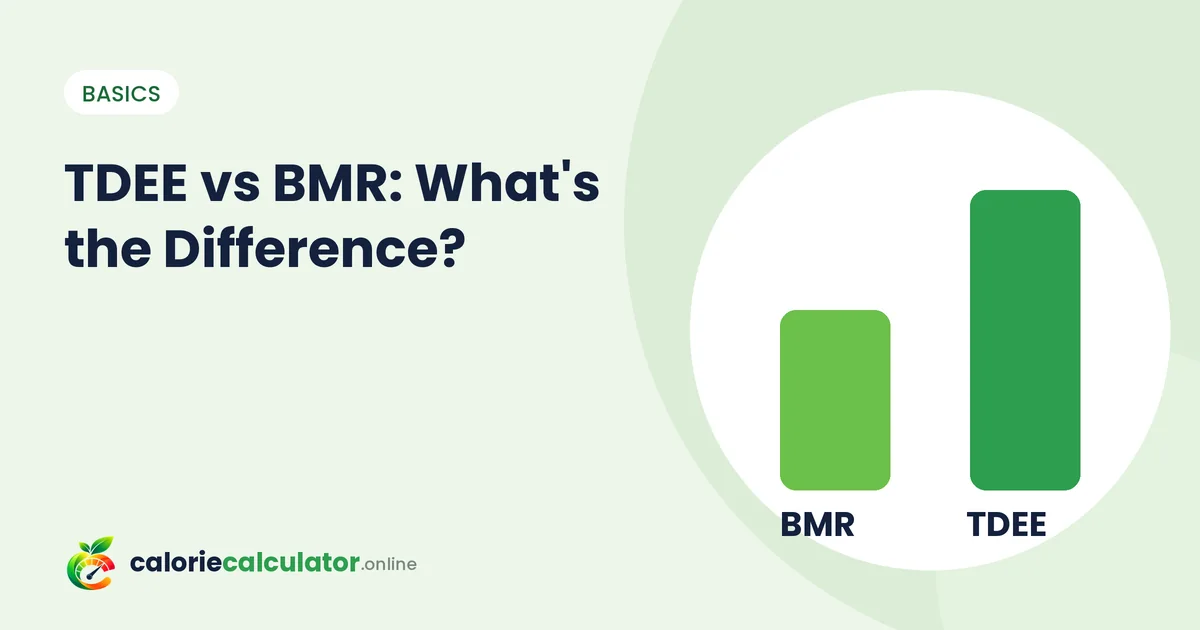
BMR is measured in strict lab conditions after a night's sleep and fasting. Resting metabolic rate (RMR) is measured under looser conditions and is usually a little higher. For everyday planning the two are close enough to use interchangeably. Read TDEE vs BMR for how to turn BMR into a calorie target.
Frequently asked questions
What is a normal BMR?
Many adult women have a BMR of about 1,200–1,500 kcal and many adult men about 1,500–1,900 kcal, depending on size and age.
Can I increase my BMR?
Building muscle raises BMR slightly. Age, height and genetics play a bigger role and can't be changed.
Should I eat only my BMR calories?
No. Your BMR does not include any movement. Eating only that much is usually too low; use your TDEE instead.
Comments & suggestions