Calorie Deficit Explained: How to Lose Weight Without Starving
A calorie deficit means eating fewer calories than your body burns in a day. For most adults, a deficit of about 500 calories a day leads to roughly 1 lb of weight loss per week. Find your maintenance calories (TDEE) first, subtract 300–500 calories, keep protein high and adjust every 2–3 weeks based on your real results.
On this page
- What is a calorie deficit?
- How big should your calorie deficit be?
- How to calculate your calorie deficit in 4 steps
- Should you create the deficit with diet or exercise?
- How to eat in a calorie deficit without starving
- Sample 1,600-calorie day
- Do you need to count calories?
- Why weight loss stalls, and what to do
- Diet breaks and refeeds
- Who should be careful with a calorie deficit
- Calorie deficit myths
- Key takeaways
- Frequently asked questions
Every successful diet, whether it's keto, intermittent fasting or plain portion control, works for the same reason: it puts you in a calorie deficit. This guide explains what a calorie deficit is, how to set one that fits your body, and how to stick with it without feeling like you're starving.
What is a calorie deficit?
A calorie deficit happens when you eat fewer calories than your body uses. Your body still needs that missing energy, so it takes it from storage, mainly body fat, plus some glycogen and, if you're not careful, some muscle.
Your body burns calories in four main ways:
- Basal metabolic rate (BMR): the energy needed to keep you alive at rest. For most people this is 60–70% of the day's total.
- Thermic effect of food: about 10% of the calories you eat are used to digest them. Protein costs the most to digest.
- Non-exercise activity (NEAT): walking to the car, standing, cleaning, fidgeting. This varies by hundreds of calories between people.
- Exercise: planned workouts such as running, lifting or cycling.
Add those together and you get your total daily energy expenditure (TDEE), also called maintenance calories. Eat at your TDEE and your weight stays about the same. Eat below it and you lose weight. You can estimate yours in seconds with our TDEE calculator.
How big should your calorie deficit be?
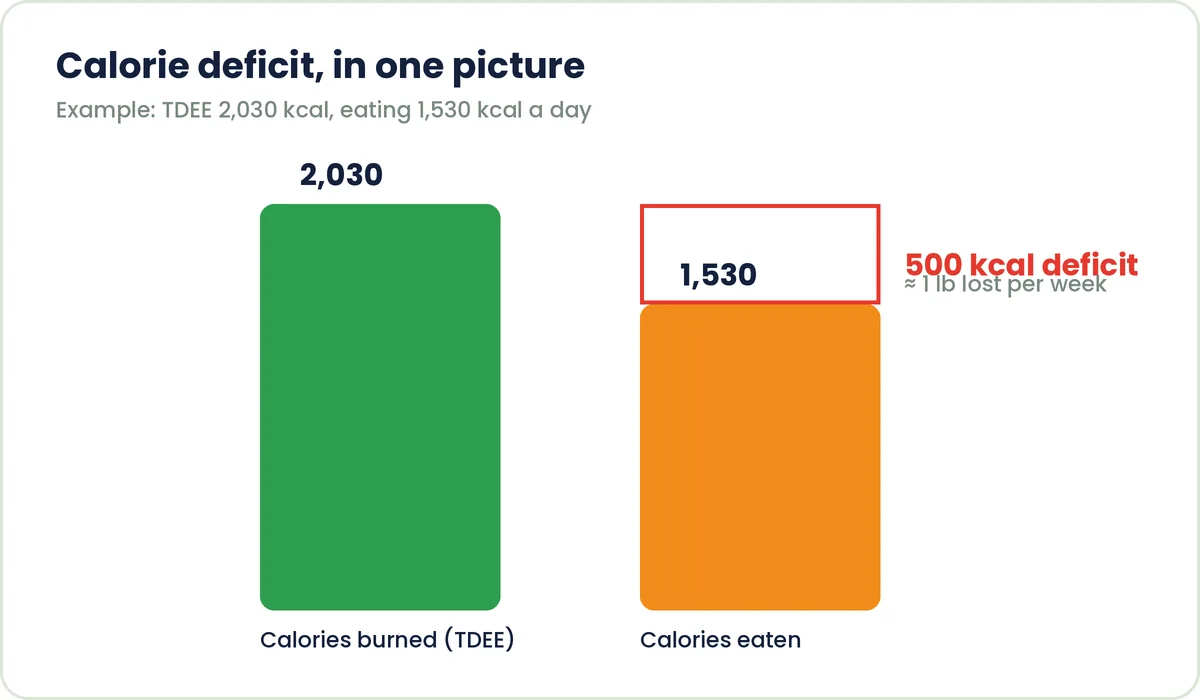
The classic rule says a pound of body fat stores about 3,500 calories, so a 500-calorie daily deficit adds up to about 1 lb lost per week. That rule is a useful starting point, although research from the US National Institutes of Health (Hall and colleagues, 2011) shows that weight loss slows over time because your body burns fewer calories as it gets smaller. So treat the numbers below as a first-month guide, not a promise for the whole year.
| Daily deficit | Expected loss per week | Best for |
|---|---|---|
| 250 calories | about 0.5 lb (0.2 kg) | Lean people, people close to their goal, anyone who wants a very gentle pace |
| 500 calories | about 1 lb (0.45 kg) | Most adults, the best balance of speed and comfort |
| 750 calories | about 1.5 lb (0.7 kg) | People with more weight to lose who are active |
| 1,000 calories | about 2 lb (0.9 kg) | People with a lot of weight to lose, for a limited time |
The US Centers for Disease Control and Prevention (CDC) notes that people who lose weight gradually, about 1 to 2 pounds a week, are more likely to keep it off. A larger deficit gets you there faster on paper, but it also brings more hunger, lower energy, more muscle loss and a higher chance of quitting.
Rule of thumb: aim to lose about 0.5–1% of your body weight per week. For a 200 lb person that's 1–2 lb a week; for a 140 lb person it's 0.7–1.4 lb a week.
How to calculate your calorie deficit in 4 steps
Step 1: Estimate your maintenance calories
Enter your age, sex, height, weight and activity level in the calorie calculator. It uses the Mifflin-St Jeor equation, which a 2005 review in the Journal of the American Dietetic Association found to be the most accurate of the common formulas for healthy adults.
Example: a 38-year-old woman, 5 ft 5 in, 175 lb, who walks most days and does two workouts a week has a BMR of about 1,475 calories. With a "Light" activity factor of 1.375, her TDEE is about 2,030 calories a day.
Step 2: Pick a pace
She chooses to lose about 1 lb a week, so she subtracts 500 calories. Her daily target is about 1,530 calories.
Step 3: Check the floor
Most health organizations suggest women don't go below about 1,200 calories a day and men don't go below about 1,500 without medical supervision. Her target is well above that, so it's a safe place to start.
Step 4: See your goal date
If she wants to reach 150 lb, that's 25 lb to lose. At 1 lb a week, the calorie deficit calculator estimates about 25 weeks, or roughly six months. Seeing a real date makes the plan feel concrete and helps with motivation.
Should you create the deficit with diet or exercise?
Both work, but food usually does the heavy lifting. It takes about 45–60 minutes of brisk walking for a 180 lb person to burn 300 calories, but only a couple of minutes to eat 300 calories of chips. That's why many experts say "you can't out-train a bad diet."
Exercise still matters for three big reasons:
- It protects muscle. Strength training two or three times a week signals your body to keep muscle while you lose fat.
- It helps you keep weight off. Studies of people in the US National Weight Control Registry, who have kept off at least 30 lb for a year or more, show that most of them exercise about an hour a day.
- It improves health on its own. Better blood pressure, blood sugar, mood and sleep, even before the scale moves.
A practical split: create most of your deficit from food (300–500 calories), and use daily walking and 2–3 strength sessions a week for health and muscle. Our calories burned calculator shows what different activities add.
How to eat in a calorie deficit without starving
Hunger is the main reason diets fail. The good news is that you can eat the same number of calories and feel very different depending on what those calories are.
1. Eat more protein
Protein is the most filling nutrient, and it helps you keep muscle. Many studies on weight loss use about 1.6–2.2 g of protein per kg of body weight (roughly 0.7–1 g per lb of goal weight). Build each meal around a protein: eggs, Greek yogurt, chicken, fish, lean beef, tofu, beans or lentils. Use the protein calculator for your number.
2. Fill half your plate with vegetables
Vegetables are high in water and fiber and low in calories. A big salad or a plate of roasted vegetables can be 100–200 calories while taking up a lot of room in your stomach. That volume helps you feel satisfied.
3. Choose high-fiber carbs
Oats, potatoes, beans, fruit, brown rice and whole-grain bread digest more slowly than white bread, candy and soda, so they keep you fuller for longer. Aim for 25–35 g of fiber a day.
4. Watch liquid calories
A large sweet coffee drink can have 400–500 calories. A 20 oz soda has about 240. Juice, alcohol and smoothies add up fast without making you feel full. Swapping them for water, sparkling water, black coffee or tea is one of the easiest deficits you can create.
5. Keep fats, but measure them
Fat is healthy and helps you absorb vitamins, but it has 9 calories per gram. One tablespoon of olive oil is about 120 calories, and many people pour three times that without noticing. Use a measuring spoon for oils, nut butters and dressings.
6. Plan your meals and snacks
Decide what you'll eat before you're hungry. A simple structure is three meals plus one planned snack, each with protein. Our macro calculator splits your calories into protein, carbs and fat per meal.
Sample 1,600-calorie day
Here's what a realistic day at about 1,600 calories and 120 g of protein can look like:
| Meal | Food | Calories | Protein |
|---|---|---|---|
| Breakfast | 2 eggs + 2 egg whites scrambled, 1 slice whole-grain toast, 1 cup berries | 340 | 26 g |
| Lunch | Big salad with 4 oz grilled chicken, chickpeas, vegetables, 1 tbsp olive oil dressing | 480 | 40 g |
| Snack | 1 cup plain Greek yogurt (2%) with cinnamon and a small apple | 250 | 20 g |
| Dinner | 5 oz salmon, 1 medium baked potato, 2 cups roasted broccoli | 530 | 36 g |
| Total | 1,600 | 122 g |
Notice that none of these meals are tiny. That's the power of choosing foods that are high in protein and volume.
Do you need to count calories?
Counting isn't required, but it helps a lot at the start. Research consistently finds that people underestimate how much they eat, often by 20–40%. Tracking for even two or three weeks with an app and a kitchen scale teaches you what portions really look like.
If you don't want to count, try these simpler methods:
- The plate method: half vegetables, a quarter protein, a quarter starch, plus a thumb of fat.
- Hand portions: a palm of protein, a fist of vegetables, a cupped hand of carbs and a thumb of fat per meal (double for most men).
- Protein first: eat your protein and vegetables before anything else on the plate.
Whichever method you use, weigh yourself 3–7 times a week and track the weekly average. Daily weight jumps around by 1–4 lb from water, salt and food in your gut, so single readings can be misleading.
Why weight loss stalls, and what to do
Almost everyone hits a plateau. Here's why, and how to break through.
Your TDEE drops as you lose weight
A smaller body burns fewer calories. Someone who loses 30 lb may burn 150–250 fewer calories a day than when they started. Your original deficit gets smaller without you changing anything. Fix: recalculate your calories every 10 lb or so.
Daily movement quietly drops
When you eat less, you tend to move less without noticing: fewer steps, more sitting. Fix: set a daily step goal. Our guide on how many steps a day to lose weight explains how much walking adds.
Portions creep up
A spoonful here, a bite there, a larger pour of oil. Fix: weigh and track everything for one week to reset.
Water retention hides fat loss
A salty meal, a hard workout, poor sleep or stress can all cause temporary water retention. Fix: be patient and look at your trend over 3–4 weeks.
If your weekly average hasn't moved in 3–4 weeks and you're sure your tracking is accurate, lower your calories by another 100–200 or add 2,000–3,000 daily steps.
Diet breaks and refeeds
Long diets are hard mentally. Some people do better with a planned diet break: one to two weeks at maintenance calories every 8–12 weeks. A 2018 study from the University of Tasmania (the MATADOR trial) found that men who alternated two weeks of dieting with two weeks at maintenance lost more fat and kept more of it off than men who dieted continuously. It's not required, but it's a useful tool if you're feeling burned out.
Who should be careful with a calorie deficit
Talk to a doctor or registered dietitian before starting a calorie deficit if you are pregnant or breastfeeding, under 18, have diabetes (especially if you take insulin or sulfonylureas), have kidney, heart or thyroid disease, take medication that affects appetite or weight, or have a history of disordered eating. See our medical disclaimer for more.
Calorie deficit myths
"Starvation mode will stop your weight loss"
Your body does adapt to eating less. Metabolism slows a little more than weight loss alone predicts, a process researchers call adaptive thermogenesis. But the effect is usually modest, often in the range of 5–15% of daily burn, and it does not stop fat loss when you're truly in a deficit. What looks like "starvation mode" is almost always water retention, less daily movement or underestimated portions.
"You have to eat six small meals to keep your metabolism up"
Meal frequency doesn't change your total daily burn in a meaningful way. Eat the number of meals that helps you control hunger. For some that's three meals; for others it's two meals and two snacks.
"Eating after 8 p.m. makes you gain weight"
Total calories across the day matter far more than timing. Late-night eating becomes a problem mainly when it's extra, mindless snacking on top of full meals. If you prefer a later dinner, just plan it into your daily total.
"Some foods have negative calories"
Celery and cucumber are very low in calories, but digesting them doesn't burn more than they contain. They're still great choices because they add volume and crunch for very few calories.
Key takeaways
- A calorie deficit means eating fewer calories than your TDEE. It's the reason every diet works.
- A 500-calorie daily deficit leads to about 1 lb of loss per week at first.
- Most people should aim for 0.5–1% of body weight per week.
- High protein, lots of vegetables, high-fiber carbs and fewer liquid calories make a deficit much easier.
- Strength training protects muscle; daily walking helps you keep weight off.
- Recalculate every 10 lb and judge progress by your 3–4 week trend.
Calculate your calorie deficit
Frequently asked questions
How many calories should I eat to be in a calorie deficit?
Eat 300–500 calories below your maintenance calories (TDEE). For example, if your TDEE is 2,300 calories, eat about 1,800–2,000 calories a day. Use a calorie calculator to estimate your TDEE first.
Is a 500 calorie deficit good?
Yes. A 500-calorie deficit is the most common recommendation because it leads to about 1 lb of weight loss per week while still allowing enough food to feel satisfied and keep muscle.
Can I lose weight without counting calories?
Yes. Methods like the plate method, hand portions, eating protein first and cutting sugary drinks can all create a calorie deficit without counting. Counting for a few weeks at the start helps you learn portion sizes.
Why am I not losing weight in a calorie deficit?
The most common reasons are underestimating portions, water retention, a drop in daily movement, or a calorie target that no longer fits your lower body weight. Track carefully for two weeks and recalculate your TDEE.
How long does it take to see results in a calorie deficit?
Most people see the scale drop within the first week, partly from water. Visible fat loss in the mirror and in how clothes fit usually shows after 3–6 weeks of consistent eating.
Will a calorie deficit make me lose muscle?
Some muscle loss is possible, especially with large deficits. Eating enough protein (about 0.7–1 g per lb of goal weight) and lifting weights 2–3 times a week keeps muscle loss to a minimum.
What is the lowest number of calories I should eat?
Most adults should not go below about 1,200 calories a day for women or 1,500 for men without medical supervision, because it becomes hard to get enough nutrients.
Sources
- Hall KD, et al. Quantification of the effect of energy imbalance on bodyweight. The Lancet, 2011.
- Frankenfield D, et al. Comparison of predictive equations for resting metabolic rate in healthy nonobese and obese adults. J Am Diet Assoc, 2005.
- Mifflin MD, St Jeor ST, et al. A new predictive equation for resting energy expenditure in healthy individuals. Am J Clin Nutr, 1990.
- Byrne NM, et al. Intermittent energy restriction improves weight loss efficiency in obese men: the MATADOR study. Int J Obes, 2018.
- Centers for Disease Control and Prevention. Losing Weight. cdc.gov.
- National Weight Control Registry. nwcr.ws.

We write practical, research-based guides on calories, nutrition and body composition, and build the free calculators on this site. Every article cites its sources and is reviewed for accuracy. Our editorial policy.
This article is for general education and is not medical advice. See our medical disclaimer.
Comments & suggestions