How Many Steps a Day to Lose Weight? Calories Burned Walking Explained
Most adults burn about 30–50 calories per 1,000 steps, so 10,000 steps burns roughly 300–500 calories. For weight loss, aim for 8,000–12,000 steps a day combined with a modest calorie deficit. If you're starting low, add 1,000–2,000 steps a day every one to two weeks.
On this page
- The short answer
- What the research says about steps
- How many calories do you burn per step?
- How many steps are in a mile?
- How much weight can you lose by walking?
- A simple 8-week walking plan
- Easy ways to get more steps
- How to burn more calories walking
- Walking vs running for weight loss
- Walking works best with the right diet
- Walking safely
- Step goals for different goals
- What a 10,000-step day looks like
- How accurate are step counters?
- Walking myths
- Walking with extra weight or joint pain
- Walking plus strength training
- Key takeaways
- Frequently asked questions
Walking is the most underrated weight-loss tool there is. It's free, easy on your joints, doesn't make you ravenous, and you can do it almost anywhere. But how many steps do you actually need to lose weight? This guide gives you the numbers, a calories-per-step chart, and a simple plan to build up.
The short answer
For most people trying to lose weight, 8,000 to 12,000 steps a day is a strong target, as long as you also eat in a modest calorie deficit. If you're currently at 3,000–4,000 steps, simply reaching 7,000–8,000 will make a real difference.
The famous 10,000-step goal actually started as a marketing slogan for a Japanese pedometer in the 1960s ("manpo-kei" means "10,000-step meter"). It's a good round number, but science now gives us better guidance.
What the research says about steps
A 2022 analysis in The Lancet Public Health (Paluch and colleagues) pooled data from 15 studies and nearly 50,000 adults. It found that the risk of early death dropped steadily as daily steps increased, leveling off at about 6,000–8,000 steps for adults 60 and older and 8,000–10,000 steps for adults under 60.
For weight loss specifically, walking works mainly by increasing the calories you burn each day. It helps most when it's combined with eating changes. On its own, adding walking without changing food usually leads to modest loss, often a few pounds over several months, because people tend to eat a little more when they move more.
Walking shines in two areas where diets often struggle:
- Keeping weight off: people who maintain large weight losses tend to be very active. Members of the US National Weight Control Registry report about an hour of activity a day, and walking is the most common choice.
- Reducing belly fat and improving health markers: regular brisk walking improves blood sugar, blood pressure and cholesterol, even before much weight is lost.
How many calories do you burn per step?
It depends mainly on your body weight and walking speed. Heavier people burn more calories per step because they move more mass. A common estimate is 0.04–0.05 calories per step for an average adult, or about 30–50 calories per 1,000 steps.
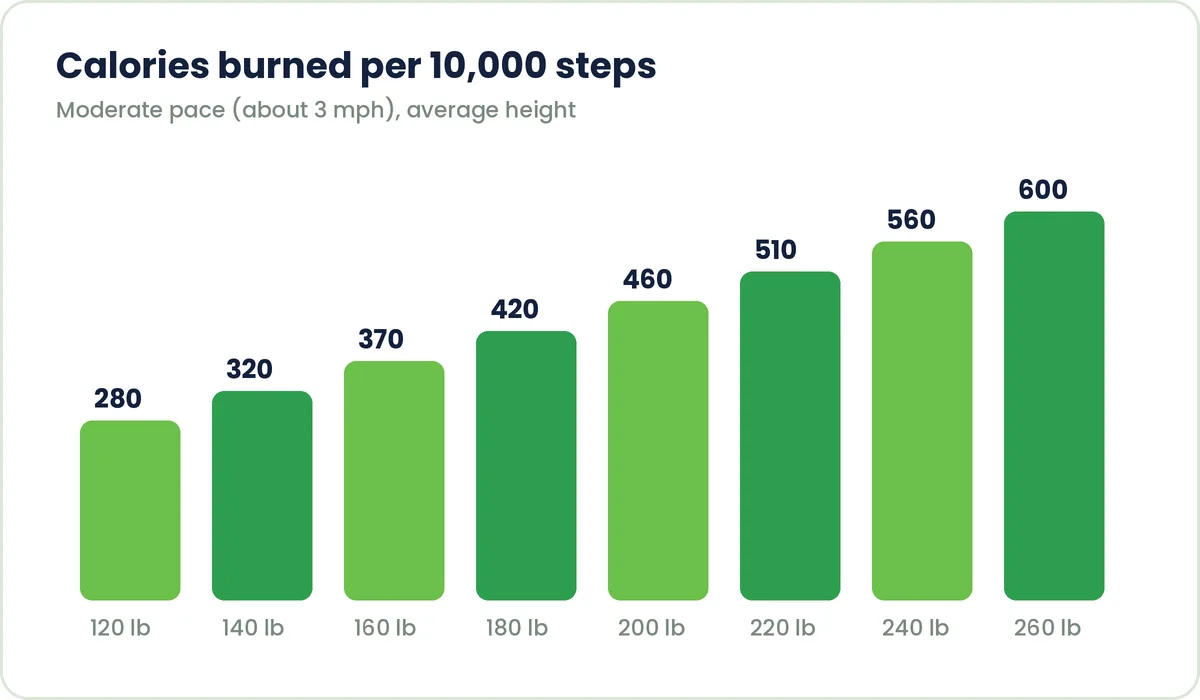
Calories burned walking by body weight
These estimates assume a moderate pace of about 3 mph (roughly 2,000–2,300 steps per mile for average height). Faster walking, hills and carrying a load all increase the burn.
| Body weight | Per 1,000 steps | 5,000 steps | 10,000 steps | 12,000 steps |
|---|---|---|---|---|
| 120 lb | 28 | 140 | 280 | 330 |
| 140 lb | 32 | 160 | 320 | 390 |
| 160 lb | 37 | 190 | 370 | 440 |
| 180 lb | 42 | 210 | 420 | 500 |
| 200 lb | 46 | 230 | 460 | 560 |
| 220 lb | 51 | 250 | 510 | 610 |
| 240 lb | 56 | 280 | 560 | 670 |
| 260 lb | 60 | 300 | 600 | 720 |
Your exact numbers depend on your height, stride length and speed. Enter your weight and steps into the calories burned calculator for a personal estimate.
How many steps are in a mile?
Most adults take about 2,000–2,500 steps per mile when walking. Taller people and faster walkers take fewer, longer steps. A quick way to estimate your stride is to multiply your height by 0.414 (for walking). A 5 ft 9 in person (69 inches) has a stride of about 28.6 inches, or about 2,220 steps per mile.
| Steps | Approximate distance | Time at 3 mph |
|---|---|---|
| 2,000 | about 1 mile | about 20 minutes |
| 5,000 | about 2.3 miles | about 45 minutes |
| 7,500 | about 3.4 miles | about 70 minutes |
| 10,000 | about 4.5 miles | about 90 minutes |
| 12,000 | about 5.4 miles | about 110 minutes |
Don't let the time column scare you. Those minutes include every step you take all day: walking around your home, at work, shopping and so on. Most people already get 3,000–5,000 steps from daily life.
How much weight can you lose by walking?
Let's do the math for a 180 lb person who goes from 4,000 to 10,000 steps a day. Those extra 6,000 steps burn about 250–280 extra calories a day, or roughly 1,750–1,950 calories a week.
Using the rough 3,500-calories-per-pound rule, that's about 0.5 lb per week, or around 2 lb a month, from walking alone, as long as eating stays the same. Pair it with a 250–500 calorie reduction in food and you're looking at about 1–1.5 lb a week.
Reality check: the 3,500-calorie rule overestimates long-term loss, because your body burns less as you get lighter. Expect progress to slow gradually and recalculate every 10 lb with the TDEE calculator.
A simple 8-week walking plan
Start from your current average. Check it in your phone's health app or fitness tracker over the last week. Then build up gradually so your feet, knees and hips can adapt.
| Weeks | Daily step goal | How to get there |
|---|---|---|
| 1–2 | Current average + 1,000 | One 10-minute walk after a meal |
| 3–4 | Current average + 2,500 | Walks after two meals, or one 25-minute walk |
| 5–6 | 8,000 | Daily 30-minute walk plus more movement at work |
| 7–8 | 10,000+ | 30–45 minute walk plus a short walk after dinner; add one hilly or brisk session a week |
Easy ways to get more steps
- Walk after meals. A 10–15 minute walk after eating also helps lower blood sugar spikes.
- Take walking calls and meetings. A 30-minute call can be 3,000 steps.
- Park farther away and take the stairs when you can.
- Set an hourly reminder to stand up and walk for 2–3 minutes.
- Walk with a friend or a podcast. It makes the time pass faster and keeps you consistent.
- Use a walking pad or treadmill at home during TV shows or at a standing desk.
- Break it up. Three 10-minute walks burn about the same as one 30-minute walk.
How to burn more calories walking
- Walk faster. Going from 2.5 mph to 3.5 mph increases the burn per minute by about 40%.
- Add hills or incline. A 5–10% treadmill incline can increase calories burned by 50% or more.
- Try intervals. Alternate 1–2 minutes of very brisk walking with 2 minutes at an easy pace.
- Carry a light backpack (rucking). Start with 10–15 lb.
- Walk on uneven ground like trails, grass or sand.
Walking vs running for weight loss
Running burns about twice as many calories per minute as walking, which is great if you're short on time. Per mile the difference is smaller: running burns only about 20–30% more per mile than walking.
Walking has advantages too: it's easier on your joints, you can do it every day, it doesn't usually increase hunger much, and you're more likely to stick with it. The best choice is the one you'll actually do consistently. Many people do well walking most days and adding 2–3 short runs or bike rides a week.
Walking works best with the right diet
Walking helps you burn more, but what you eat still decides most of your results. A few tips:
- Don't "eat back" your steps. If you set your calorie target with an activity level that includes your walking, adding the tracker's step calories on top counts them twice.
- Keep protein high so you keep muscle as you lose weight. See our guide to macros for weight loss.
- Re-check your activity level. Going from 4,000 to 10,000 steps can move you from "Sedentary" to "Moderately active" in the calorie calculator.
Walking safely
Wear supportive shoes and replace them every 300–500 miles. Increase your steps gradually. If you have heart disease, diabetes, joint problems or haven't exercised in a long time, check with your doctor before starting a new routine. Stop and get help if you feel chest pain, severe shortness of breath or dizziness.
Step goals for different goals
| Goal | Daily steps | Notes |
|---|---|---|
| Basic health (60+) | 6,000–8,000 | Where most of the longevity benefit levels off for older adults |
| Basic health (under 60) | 8,000–10,000 | Where most of the benefit levels off for younger adults |
| Weight loss | 8,000–12,000 | Combine with a 250–500 calorie deficit |
| Keeping weight off | 10,000+ | Plus 150–300 minutes of moderate exercise a week |
| Blood sugar control | Any, plus walks after meals | 10–15 minutes after eating helps lower glucose spikes |
The Physical Activity Guidelines for Americans recommend at least 150 minutes of moderate activity a week, such as brisk walking, plus two days of muscle-strengthening activity. A daily 30-minute brisk walk, five days a week, meets the aerobic part.
What a 10,000-step day looks like
Hitting 10,000 steps is easier when you spread it out. Here's a realistic day for someone with a desk job:
| Time | Activity | Steps |
|---|---|---|
| Morning | Getting ready, walking to the car or bus | 1,000 |
| Work (morning) | Normal movement plus a 5-minute walk every 2 hours | 1,500 |
| Lunch | 15-minute walk after eating | 1,800 |
| Work (afternoon) | Walking meeting or phone call | 2,000 |
| Evening | 20-minute walk after dinner | 2,400 |
| Home | Chores, cooking, errands | 1,500 |
| Total | 10,200 |
How accurate are step counters?
Most modern phones and wrist trackers count steps within about 5–10% when you're walking normally. They're less accurate for slow shuffling, pushing a cart or stroller (your wrist doesn't swing), and activities like cycling. Calorie estimates from trackers are much less reliable than step counts, often overestimating by 20% or more.
Use your tracker for what it does well, counting steps and spotting trends, and use a formula-based calculator for calories.
Walking myths
"Walking is too easy to help with weight loss"
Walking burns fewer calories per minute than running, but because you can do a lot of it every day without getting exhausted or injured, the weekly total adds up. A 200 lb person who walks an extra 5,000 steps daily burns about 1,600 extra calories a week.
"You have to do all your steps at once"
Short walks spread through the day count just as much, and walking after meals has extra benefits for blood sugar.
"Walking will make you really hungry"
Compared with intense exercise, moderate walking usually has a small effect on appetite. Many people find a walk actually helps with cravings and stress eating.
Walking with extra weight or joint pain
If you have a lot of weight to lose, or your knees, hips or feet hurt, walking is still one of the best places to start. A few adjustments help:
- Start short and often. Five to ten minutes, two or three times a day, is easier on joints than one long walk.
- Choose soft, flat surfaces like tracks, trails or treadmills rather than steep, uneven sidewalks.
- Invest in good shoes with cushioning and a wide toe box. A running store can check your gait for free.
- Try water walking in a pool if land walking hurts. The water supports your weight while still burning calories.
- Use the talk test. You should be able to talk but not sing. That's moderate intensity, and it's enough.
- Strengthen your legs. Simple exercises like sit-to-stands from a chair and step-ups make walking easier and protect your knees.
Walking plus strength training
Walking is great for burning calories and heart health, but it doesn't do much to build muscle. When you lose weight, some of what you lose can be muscle, which lowers your daily calorie burn and makes weight regain more likely.
Adding two or three short strength sessions a week fixes this. They don't need to be long or complicated. A 20–30 minute routine with squats (or sit-to-stands), push-ups (against a wall or counter if needed), rows with a resistance band or dumbbells, lunges or step-ups, and planks is enough to start. Combine that with daily walking and enough protein, and most of the weight you lose will be fat.
Key takeaways
- Aim for 8,000–12,000 steps a day for weight loss, built up gradually.
- Most adults burn 30–50 calories per 1,000 steps; heavier people burn more.
- 10,000 steps is about 4–5 miles and 300–500 calories for most adults.
- Walking alone gives modest weight loss; with a small calorie deficit it's very effective.
- Walking faster, adding hills and walking after meals increase the benefits.
Calculate calories from your steps
Frequently asked questions
How many steps a day should I walk to lose weight?
For most people, 8,000–12,000 steps a day combined with a modest calorie deficit works well. If you're starting from a low number, add 1,000–2,000 steps every week or two.
How many calories does 10,000 steps burn?
Most adults burn about 300–500 calories walking 10,000 steps. A 150 lb person burns about 350 calories and a 200 lb person about 460, at a moderate pace.
Can I lose belly fat by walking?
Walking helps reduce overall body fat, including belly fat, especially when combined with a calorie deficit. You can't target fat loss to one area, but visceral belly fat often responds well to regular aerobic activity.
Is walking 30 minutes a day enough to lose weight?
Thirty minutes of brisk walking burns about 120–200 calories for most adults. It supports weight loss best when combined with a small reduction in calories.
How many steps are in a mile?
Most adults take about 2,000–2,500 steps per mile when walking. Taller people and faster walkers take fewer steps per mile.
Is it better to walk fast or walk longer?
Both help. Walking faster burns more per minute, while walking longer adds more total calories. A mix of daily longer walks and a few brisk or hilly sessions each week works well.
Sources
- Paluch AE, et al. Daily steps and all-cause mortality: a meta-analysis of 15 international cohorts. The Lancet Public Health, 2022.
- Tudor-Locke C, et al. How many steps/day are enough? For adults. Int J Behav Nutr Phys Act, 2011.
- Herrmann SD, Ainsworth BE, et al. 2024 Adult Compendium of Physical Activities. J Sport Health Sci, 2024.
- US Department of Health and Human Services. Physical Activity Guidelines for Americans, 2nd edition, 2018.
- National Weight Control Registry. nwcr.ws.

We write practical, research-based guides on calories, nutrition and body composition, and build the free calculators on this site. Every article cites its sources and is reviewed for accuracy. Our editorial policy.
This article is for general education and is not medical advice. See our medical disclaimer.
Comments & suggestions