How Many Calories Do I Burn a Day? TDEE by Age, Weight and Activity
Most adult women burn about 1,800–2,400 calories a day and most adult men burn about 2,200–3,000, depending on size, age and activity. Your exact number, called TDEE, equals your resting metabolic rate (BMR) multiplied by an activity factor from 1.2 (sedentary) to 1.9 (very active).
On this page
- The short answer
- Where do your calories go?
- How your daily burn is calculated
- Calories burned per day: charts by age and weight
- What affects how many calories you burn?
- How many calories do you burn at rest?
- How accurate are these estimates?
- How to burn more calories each day
- How to use your number
- Calories burned by common activities
- How much everyday movement adds up
- Metabolism myths
- Three real-world examples
- How many calories to gain weight or muscle?
- Key takeaways
- Frequently asked questions
"How many calories do I burn a day?" is one of the most searched fitness questions, and for good reason. Once you know the number, you know exactly how much to eat to lose, keep or gain weight. This guide gives you quick answers, charts by age and weight, and a clear explanation of what changes your daily burn.
The short answer
According to the Dietary Guidelines for Americans, adult women need roughly 1,600–2,400 calories a day and adult men roughly 2,000–3,000 calories, with the lower end for sedentary people and the higher end for active people. The number you burn is the same as the number you need to maintain your weight.
Those ranges are wide because calorie burn depends on your body size, muscle, age and how much you move. For a personal estimate, use the TDEE calculator. It takes about ten seconds.
Where do your calories go?
Scientists split your total daily energy expenditure (TDEE) into four parts:
| Component | Share of daily burn | What it is |
|---|---|---|
| Basal metabolic rate (BMR) | 60–70% | Breathing, heartbeat, brain, organs, body temperature |
| Thermic effect of food (TEF) | about 10% | Digesting and absorbing food |
| Non-exercise activity (NEAT) | 15–30% (varies a lot) | Walking, standing, chores, fidgeting |
| Exercise (EAT) | 0–15% for most people | Planned workouts |
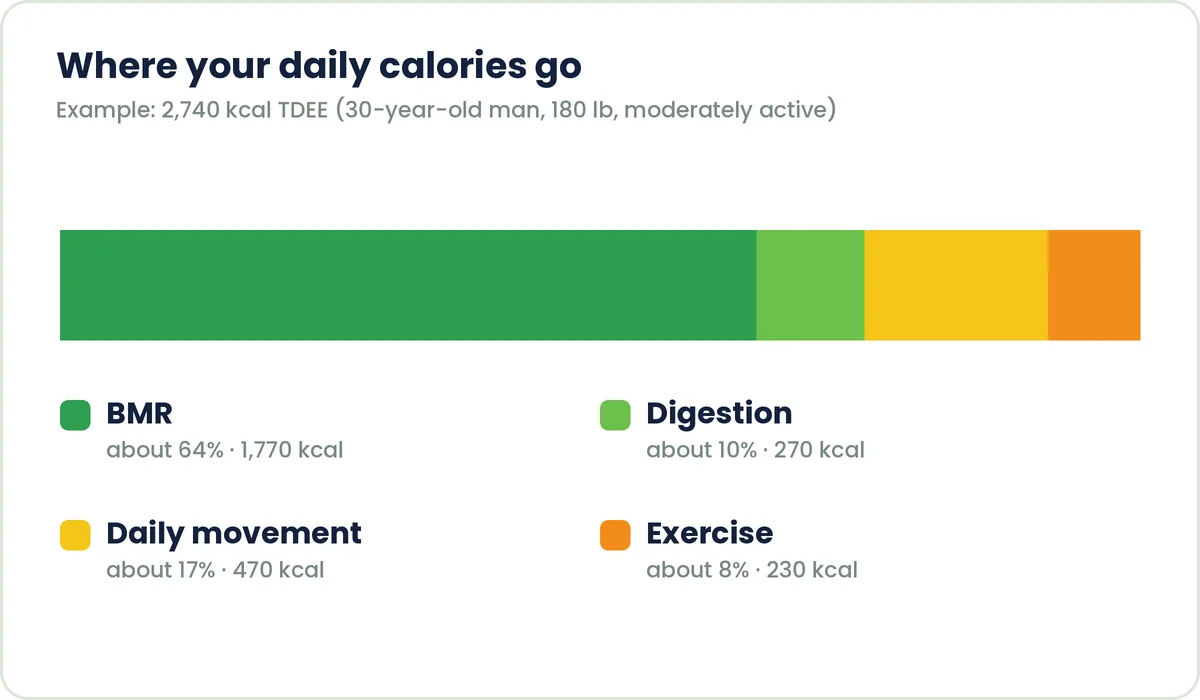
Two things surprise most people. First, most of your calories are burned just keeping you alive. Second, everyday movement (NEAT) usually burns more than formal exercise. A 2005 Mayo Clinic study by James Levine found that NEAT differences of up to 350 calories a day explained why some people gained weight more easily than others.
How your daily burn is calculated
Most calculators, including ours, use two steps:
1. Estimate your BMR
The Mifflin-St Jeor equation is the most accurate everyday formula for healthy adults:
To convert: 1 lb = 0.4536 kg and 1 inch = 2.54 cm. Our BMR calculator also shows the Harris-Benedict and Katch-McArdle formulas side by side.
2. Multiply by an activity factor
| Activity level | Description | Multiplier |
|---|---|---|
| Sedentary | Desk job, little or no exercise, under ~5,000 steps | 1.2 |
| Lightly active | Exercise 1–3 days a week or ~5,000–7,500 steps | 1.375 |
| Moderately active | Exercise 3–5 days a week or ~7,500–10,000 steps | 1.55 |
| Very active | Hard exercise 6–7 days a week or 10,000+ steps | 1.725 |
| Extremely active | Physical job plus training, or athletes training twice a day | 1.9 |
Example: A 30-year-old man, 5 ft 9 in, 180 lb, has a BMR of about 1,767 calories. If he's moderately active, his TDEE is 1,767 × 1.55 = about 2,740 calories a day.
Calories burned per day: charts by age and weight
These estimates use Mifflin-St Jeor with a moderate activity factor (1.55). Height is set at 5 ft 4 in for women and 5 ft 9 in for men, close to US averages.
Women (5 ft 4 in, moderately active)
| Weight | Age 25 | Age 35 | Age 45 | Age 55 | Age 65 |
|---|---|---|---|---|---|
| 130 lb | 2,050 | 1,970 | 1,890 | 1,810 | 1,740 |
| 150 lb | 2,190 | 2,110 | 2,030 | 1,950 | 1,880 |
| 170 lb | 2,330 | 2,250 | 2,170 | 2,090 | 2,020 |
| 190 lb | 2,470 | 2,390 | 2,310 | 2,230 | 2,160 |
| 210 lb | 2,610 | 2,530 | 2,450 | 2,380 | 2,300 |
Men (5 ft 9 in, moderately active)
| Weight | Age 25 | Age 35 | Age 45 | Age 55 | Age 65 |
|---|---|---|---|---|---|
| 150 lb | 2,570 | 2,490 | 2,410 | 2,330 | 2,260 |
| 170 lb | 2,710 | 2,630 | 2,550 | 2,470 | 2,400 |
| 190 lb | 2,850 | 2,770 | 2,690 | 2,620 | 2,540 |
| 210 lb | 2,990 | 2,910 | 2,830 | 2,760 | 2,680 |
| 230 lb | 3,130 | 3,050 | 2,970 | 2,900 | 2,820 |
If you're sedentary, multiply these numbers by about 0.77. If you're very active, multiply by about 1.11. For your exact height, use the calorie calculator.
What affects how many calories you burn?
Body size
Bigger bodies burn more calories, both at rest and when moving. That's why your calorie needs drop as you lose weight, and why tall people can often eat more than short people.
Muscle mass
Muscle burns more energy at rest than fat, though less than people often think: roughly 6 calories per pound of muscle per day versus about 2 for fat. Gaining 5 lb of muscle might add only 20–30 calories a day at rest, but muscle also lets you train harder and move more, which adds up.
Age
A large 2021 study in Science by Pontzer and colleagues, which analyzed over 6,400 people, found that metabolism (adjusted for body size) stays fairly stable from about age 20 to 60, then slowly declines by about 0.7% a year. Much of the "slower metabolism" people notice in their 30s and 40s is actually less daily movement and some muscle loss.
Sex
Men usually burn more calories than women of the same weight because they tend to have more muscle and less fat. The formulas account for this with a different constant.
Daily movement (NEAT)
This is the biggest variable you control. A desk worker who takes 4,000 steps a day and a nurse who takes 15,000 can differ by 400–600 calories a day even at the same weight.
Other factors
Genetics, sleep, thyroid function, certain medications, pregnancy and very cold or hot environments can all nudge your daily burn up or down. If you suspect a thyroid problem or another medical issue, talk to your doctor.
How many calories do you burn at rest?
Your resting burn is your BMR. For most adult women it's around 1,200–1,500 calories a day; for most adult men it's around 1,500–1,900. Even lying in bed all day, you burn more than you might expect: your brain alone uses about 20% of your resting energy.
Sleeping burns slightly less than being awake and resting, around 50–70 calories per hour for many adults. Try our BMR calculator to see your number.
How accurate are these estimates?
Formulas are usually within about 10% of lab-measured values for most people, but some individuals fall outside that. Fitness trackers are often less accurate for total calories: a 2017 Stanford study found that wrist devices measured heart rate well but were off by 27–93% on calories burned.
The most accurate method you can use at home is simple:
- Eat a consistent, tracked number of calories for 2–3 weeks.
- Weigh yourself several times a week and compare weekly averages.
- If your weight is stable, that intake is your TDEE. If you lost 1 lb a week, your TDEE is about 500 calories higher than your intake.
How to burn more calories each day
- Walk more. Adding 3,000 steps (about 1.5 miles) burns roughly 100–150 extra calories for most adults. See our guide on how many steps a day to lose weight.
- Lift weights 2–3 times a week. It builds and protects muscle, especially important after age 40.
- Break up sitting. Stand or walk for a few minutes every hour. Take calls standing up.
- Eat enough protein. Protein has the highest thermic effect: about 20–30% of its calories are used for digestion, compared with 5–10% for carbs and 0–3% for fat.
- Sleep 7–9 hours. Poor sleep lowers daily activity and increases hunger hormones.
Use the calories burned calculator to see how much specific activities add to your day.
How to use your number
- To maintain weight: eat at your TDEE.
- To lose about 1 lb a week: eat about 500 calories below it. Read the calorie deficit guide.
- To gain muscle slowly: eat 200–300 calories above it and train with weights.
- To plan your meals: split your calories into protein, carbs and fat with the macro calculator.
Calories burned by common activities
Here's roughly how many calories a 155 lb (70 kg) person burns in 30 minutes, based on MET values from the Compendium of Physical Activities. Heavier people burn more; lighter people burn less.
| Activity (30 minutes) | MET | Calories |
|---|---|---|
| Sitting, desk work | 1.3 | about 45 |
| Cooking or light housework | 2.5 | about 90 |
| Walking, 3 mph | 3.5 | about 125 |
| Weight lifting, general | 3.5 | about 125 |
| Gardening | 3.8 | about 135 |
| Walking briskly, 3.5 mph | 4.3 | about 150 |
| Cycling, 12–14 mph | 8.0 | about 280 |
| Swimming laps, moderate | 8.3 | about 290 |
| Running, 6 mph | 9.8 | about 345 |
Calories = MET × body weight in kg × hours. For your own weight and activity, use the calories burned calculator.
How much everyday movement adds up
Two people with the same BMR can have very different TDEEs purely because of how they spend their day. Compare these two 170 lb adults:
| Office worker | Retail worker | |
|---|---|---|
| Commute | Drives, 2 × 30 min sitting | Walks to transit, 2 × 15 min |
| Work day | Sits 8 hours | Stands and walks 8 hours |
| Evening | TV, 3 hours | Cooks, walks the dog, 1 hour |
| Steps | about 4,000 | about 13,000 |
| Estimated extra burn | baseline | +400 to +600 calories a day |
That gap equals about 1 lb of body fat every week or two. It's why "move more during the day" is often more powerful than adding one more gym session.
Metabolism myths
"Some foods boost your metabolism"
Green tea, chili peppers and coffee can raise calorie burn slightly, usually by less than 50–100 calories a day. Nice, but not a weight-loss plan.
"Eating small meals often speeds up metabolism"
The energy you use to digest food depends on how much you eat in total, not how often. Three meals and six mini-meals of the same calories burn about the same.
"My metabolism is broken"
Metabolism can slow modestly after long diets, and some medical conditions (such as an underactive thyroid) lower it. But a truly "broken" metabolism is rare. If you're worried, ask your doctor about thyroid tests.
"Muscle burns 50 calories per pound per day"
A popular gym myth. The real figure is closer to 6 calories per pound at rest. Muscle's real value is that it helps you move more, train harder and stay healthy as you age.
Three real-world examples
To show how much the numbers vary, here are three different people run through the same formula.
Sarah, 28, active nurse
Sarah is 5 ft 3 in and 145 lb. She works 12-hour shifts on her feet and goes to spin class twice a week. Her BMR is about 1,360 calories. Because her job keeps her moving all day, "Very active" (1.725) fits her, giving a TDEE of about 2,340 calories. That's more than many people expect for a woman her size, and it explains why she feels hungry on workdays.
David, 52, office manager
David is 6 ft and 235 lb. He drives to work, sits most of the day and rarely exercises. His BMR is about 1,950 calories. At "Sedentary" (1.2), his TDEE is about 2,345 calories, almost exactly the same as Sarah's, even though he weighs 90 lb more. If David started walking 8,000 steps a day, his TDEE would rise by roughly 300–400 calories.
Linda, 61, retired teacher
Linda is 5 ft 6 in and 180 lb. She walks her dog every morning and gardens a few times a week. Her BMR is about 1,400 calories, and at "Light" (1.375) her TDEE is about 1,920 calories. To lose about 1 lb a week, she'd eat around 1,420–1,500 calories, still above the recommended minimum for women, with a focus on protein to protect muscle at her age.
The lesson: your daily burn depends far more on your size and how you live than on your age or a "fast" or "slow" metabolism.
How many calories to gain weight or muscle?
If you're trying to gain muscle, eat about 200–300 calories above your TDEE and lift weights 3–4 times a week. Beginners can often gain 1–2 lb of muscle a month; experienced lifters gain more slowly. A bigger surplus mostly adds fat, not extra muscle. Aim to gain about 0.25–0.5% of body weight per week and keep protein around 0.7–1 g per lb.
Key takeaways
- Most women burn 1,800–2,400 calories a day and most men 2,200–3,000, depending on size and activity.
- 60–70% of your calories are burned at rest; daily movement usually beats formal exercise.
- TDEE = BMR × activity factor. Be honest about your activity level.
- Metabolism is fairly stable until about 60; less movement and muscle loss explain most midlife changes.
- Test your estimate against real weight changes over 2–3 weeks.
Frequently asked questions
How many calories do I burn a day without exercise?
Without exercise, most people burn their BMR times about 1.2. For many women that's about 1,500–1,900 calories a day, and for many men about 1,900–2,300, depending on body size and age.
How many calories does the body burn at rest?
At complete rest, most adult women burn about 1,200–1,500 calories a day and most adult men about 1,500–1,900. This is called your basal metabolic rate (BMR).
How many calories do I burn sleeping?
Most adults burn about 50–70 calories per hour while sleeping, or roughly 400–550 calories over a full night, depending on body size.
Does metabolism slow down with age?
A 2021 study in Science found metabolism stays fairly stable from about 20 to 60 when adjusted for body size, then declines slowly. Less daily movement and muscle loss explain most changes people notice in midlife.
How accurate is a TDEE calculator?
TDEE calculators are usually within about 10% for most people. Check your estimate by tracking your calories and body weight for two to three weeks.
Do fitness trackers measure calories burned accurately?
Not very. Research from Stanford found wrist trackers could be off by 27% to 93% for calories burned, even though heart rate readings were fairly accurate.
Sources
- Pontzer H, et al. Daily energy expenditure through the human life course. Science, 2021.
- Levine JA, et al. Interindividual variation in posture allocation: possible role in human obesity. Science, 2005.
- Mifflin MD, St Jeor ST, et al. A new predictive equation for resting energy expenditure in healthy individuals. Am J Clin Nutr, 1990.
- Shcherbina A, et al. Accuracy in wrist-worn, sensor-based measurements of heart rate and energy expenditure in a diverse cohort. J Pers Med, 2017.
- US Department of Agriculture and US Department of Health and Human Services. Dietary Guidelines for Americans, 2020–2025, Appendix 2.

We write practical, research-based guides on calories, nutrition and body composition, and build the free calculators on this site. Every article cites its sources and is reviewed for accuracy. Our editorial policy.
This article is for general education and is not medical advice. See our medical disclaimer.
Comments & suggestions