BMI vs Body Fat Percentage: Which Matters More for Your Health?
BMI compares weight to height and is a quick screening tool, but it can't tell fat from muscle. Body fat percentage measures how much of your weight is fat, so it's more accurate for judging health and fitness. For most adults, a healthy body fat range is about 14–24% for men and 21–31% for women, alongside a waist under half your height.
On this page
- What is BMI?
- What is body fat percentage?
- Where BMI goes wrong
- Why BMI is still useful
- How to measure body fat
- The simplest extra measure: your waist
- Which should you track?
- How to improve your body composition
- BMI chart: weight ranges by height
- Visceral fat: the fat that matters most
- How age and sex change the picture
- My BMI is high. What should I do?
- Same BMI, very different bodies
- Key takeaways
- Frequently asked questions
Your doctor probably checks your BMI. Your gym might talk about body fat percentage. Both try to answer the same question, "Is my weight healthy?", but they measure very different things. This guide explains how each works, where each goes wrong, and which numbers are worth tracking.
What is BMI?
Body Mass Index (BMI) is your weight relative to your height:
Or in metric: weight in kilograms divided by height in meters squared. A person who is 5 ft 9 in and 180 lb has a BMI of about 26.6.
BMI was created in the 1830s by the Belgian mathematician Adolphe Quetelet to study populations, not individuals. It became a medical standard in the 1970s and 1990s because it is free, fast and correlates reasonably well with body fat across large groups of people.
BMI categories for adults
| BMI | Category (CDC / WHO) |
|---|---|
| Below 18.5 | Underweight |
| 18.5 – 24.9 | Healthy weight |
| 25.0 – 29.9 | Overweight |
| 30.0 – 34.9 | Obesity class 1 |
| 35.0 – 39.9 | Obesity class 2 |
| 40 and above | Obesity class 3 (severe) |
Check yours with the BMI calculator. These categories apply to adults 20 and older. Children and teens use age- and sex-specific percentiles instead.
What is body fat percentage?
Body fat percentage is the share of your total weight that is fat. If you weigh 180 lb and have 36 lb of fat, your body fat is 20%. Everything else, including muscle, bone, water and organs, is your lean mass.
Some fat is essential for life. It protects organs, stores vitamins, and makes hormones. Men need at least about 2–5% and women about 10–13% for basic body functions.
Body fat percentage chart
| Category | Women | Men |
|---|---|---|
| Essential fat | 10–13% | 2–5% |
| Athletes | 14–20% | 6–13% |
| Fitness | 21–24% | 14–17% |
| Average | 25–31% | 18–24% |
| Obese | 32% and above | 25% and above |
Source: American Council on Exercise (ACE). Healthy ranges also shift a little with age; many people carry a few more percent body fat after 50 while staying healthy.
Where BMI goes wrong
BMI treats every pound the same, whether it's muscle, fat, bone or water. That creates predictable errors:
1. Muscular people look "overweight"
A 5 ft 10 in man who weighs 200 lb has a BMI of 28.7, "overweight." If he lifts weights and has 13% body fat, he's actually lean. Many pro athletes and even fit military members fall into the overweight or obese BMI categories.
2. "Normal weight" can hide excess fat
Someone can have a healthy BMI but high body fat and little muscle, sometimes called normal-weight obesity. A study of over 13,000 US adults published in the European Heart Journal (Romero-Corral and colleagues, 2010) found that people with normal BMI but high body fat had a higher rate of metabolic problems, such as high blood pressure and cholesterol.
3. It misses where fat is stored
Fat around your organs (visceral fat) is much more strongly linked to heart disease and type 2 diabetes than fat under the skin on your hips and thighs. BMI can't tell the difference.
4. It varies across ethnic groups
At the same BMI, people of South Asian, East Asian and some other backgrounds tend to have more body fat and higher diabetes risk. The American Diabetes Association recommends diabetes screening at a BMI of 23 or higher for Asian Americans, compared with 25 for most other groups.
5. It changes with age
Older adults lose muscle and bone, so a stable BMI can hide rising body fat. Some research suggests a BMI slightly above 25 may carry no extra risk, or even lower risk, in people over 65.
In 2023, the American Medical Association adopted a policy recognizing these limits and encouraging doctors to use BMI together with other measures such as waist size and body composition.
Why BMI is still useful
Despite its flaws, BMI isn't useless:
- It needs only a scale and a tape measure, so anyone can check it anywhere.
- For most non-athletes, a BMI of 30 or higher does reflect excess body fat.
- It tracks well with health risks across large populations.
- It's consistent: two doctors will get the same number.
Think of BMI as a screening tool, a first check that tells you whether to look closer, not a final verdict.
How to measure body fat
| Method | Typical accuracy | Cost and access |
|---|---|---|
| DEXA scan | Very high (about ±1–2%) | $50–150 at clinics and some gyms |
| Hydrostatic (underwater) weighing | High (about ±2%) | Universities, research labs |
| Bod Pod (air displacement) | High (about ±2–3%) | Some gyms and universities |
| US Navy tape method | Moderate (about ±3–4%) | Free, just a tape measure |
| Skinfold calipers | Moderate; depends on skill | Low cost; best done by a trainer |
| Smart scales (bioimpedance) | Low to moderate; affected by hydration | $30–150, easy to use daily |
For most people, the US Navy method is the best free option. It uses your height and neck and waist measurements (plus hips for women). Try it with our body fat calculator. The key is consistency: measure at the same time of day, in the same way, every few weeks.
How to measure for the Navy method
- Neck: just below the larynx (Adam's apple), with the tape angled slightly down in front.
- Waist: men at the belly button; women at the narrowest point of the waist.
- Hips (women): at the widest part of the buttocks.
- Stand straight and relaxed, breathe out normally, and don't pull the tape tight.
- Measure twice and use the average.
The simplest extra measure: your waist
If you only add one number to BMI, make it your waist. The CDC and the National Institutes of Health note that a waist larger than 40 inches for men or 35 inches for women signals higher risk for type 2 diabetes and heart disease.
An even simpler rule is the waist-to-height ratio: keep your waist less than half your height. For a 5 ft 6 in (66-inch) person, that means a waist under 33 inches. The UK's National Institute for Health and Care Excellence (NICE) adopted this guidance in 2022 because it works across sexes and ethnic groups.
Which should you track?
Use them together. Here's a simple system:
- BMI: check it a few times a year as a general screen.
- Waist size: measure once a month. It's the easiest way to spot changes in belly fat.
- Body fat %: estimate every 4–8 weeks, especially if you lift weights or are changing your body composition.
- Body weight: weigh several times a week and watch the weekly average.
If your BMI is high but your waist is under half your height and your body fat is in the fitness range, you're likely carrying muscle, not excess fat. If your BMI is normal but your waist and body fat are high, focus on strength training and protein to build muscle while reducing fat.
How to improve your body composition
- Strength train 2–3 times a week. It's the most effective way to build or keep muscle at any age.
- Eat enough protein: about 0.7–1 g per lb of goal body weight when losing fat. Get your number from the protein calculator.
- Use a moderate calorie deficit if you need to lose fat. See the calorie deficit guide.
- Walk daily. It burns fat without hurting recovery from strength training. See how many steps a day to lose weight.
- Sleep 7–9 hours and manage stress; both affect where your body stores fat.
To see a realistic target weight for your height, try the ideal weight calculator.
BMI chart: weight ranges by height
This table shows the weight ranges for each BMI category at common adult heights. Find your height, then see which range your weight falls into.
| Height | Underweight | Healthy | Overweight | Obese |
|---|---|---|---|---|
| 4 ft 10 in | under 89 lb | 89–119 lb | 120–143 lb | 144 lb+ |
| 5 ft 0 in | under 95 lb | 95–128 lb | 128–153 lb | 154 lb+ |
| 5 ft 2 in | under 101 lb | 101–136 lb | 137–163 lb | 164 lb+ |
| 5 ft 4 in | under 108 lb | 108–145 lb | 146–174 lb | 175 lb+ |
| 5 ft 6 in | under 115 lb | 115–154 lb | 155–185 lb | 186 lb+ |
| 5 ft 8 in | under 122 lb | 122–164 lb | 164–197 lb | 197 lb+ |
| 5 ft 10 in | under 129 lb | 129–174 lb | 174–208 lb | 209 lb+ |
| 6 ft 0 in | under 136 lb | 136–184 lb | 184–220 lb | 221 lb+ |
| 6 ft 2 in | under 144 lb | 144–194 lb | 194–233 lb | 233 lb+ |
| 6 ft 4 in | under 152 lb | 152–205 lb | 205–246 lb | 246 lb+ |
For your exact height, use the BMI calculator.
Visceral fat: the fat that matters most
Not all fat is equal. Subcutaneous fat sits under your skin, on your hips, thighs and arms. Visceral fat sits deep in your belly around your liver, intestines and other organs. Visceral fat is more active: it releases inflammatory substances and fatty acids that affect blood sugar, cholesterol and blood pressure.
Neither BMI nor the bathroom scale can see visceral fat directly. Your waist measurement is the best simple clue. A large waist, especially with a relatively normal BMI, often points to more visceral fat.
The good news: visceral fat tends to respond well to regular exercise, a moderate calorie deficit, less alcohol and better sleep. It's often among the first fat to go when people start exercising.
How age and sex change the picture
Women
Women naturally carry more body fat than men at the same BMI, mostly because of fat needed for hormones and reproduction. After menopause, falling estrogen tends to shift fat storage from the hips toward the belly, which raises visceral fat even if weight stays the same. Strength training and adequate protein become especially important after 40.
Men
Men tend to store more fat around the belly at every age, which is why the waist cutoff for men is 40 inches. Muscle mass gradually declines from the 30s onward, about 3–8% per decade, unless it's maintained with resistance training.
Older adults
For people over 65, keeping muscle is often more important than reaching a low BMI. Losing weight without strength training can mean losing muscle and bone, which raises the risk of falls and fractures. Many experts focus on waist size, strength and physical function in older adults rather than BMI alone.
My BMI is high. What should I do?
- Measure your waist. If it's under half your height, your BMI may reflect muscle more than fat.
- Estimate body fat with the tape method to get a second opinion.
- Talk to your doctor about blood pressure, blood sugar and cholesterol. These tell you far more about health risk than BMI alone.
- If you want to lose fat, set a realistic calorie target with the calorie calculator and aim for 0.5–1% of body weight per week.
- Focus on habits, not just the number: daily walking, strength training, protein at each meal and 7–9 hours of sleep.
Even a 5–10% weight loss can improve blood pressure, blood sugar and cholesterol, according to the CDC, long before you reach a "normal" BMI.
Same BMI, very different bodies
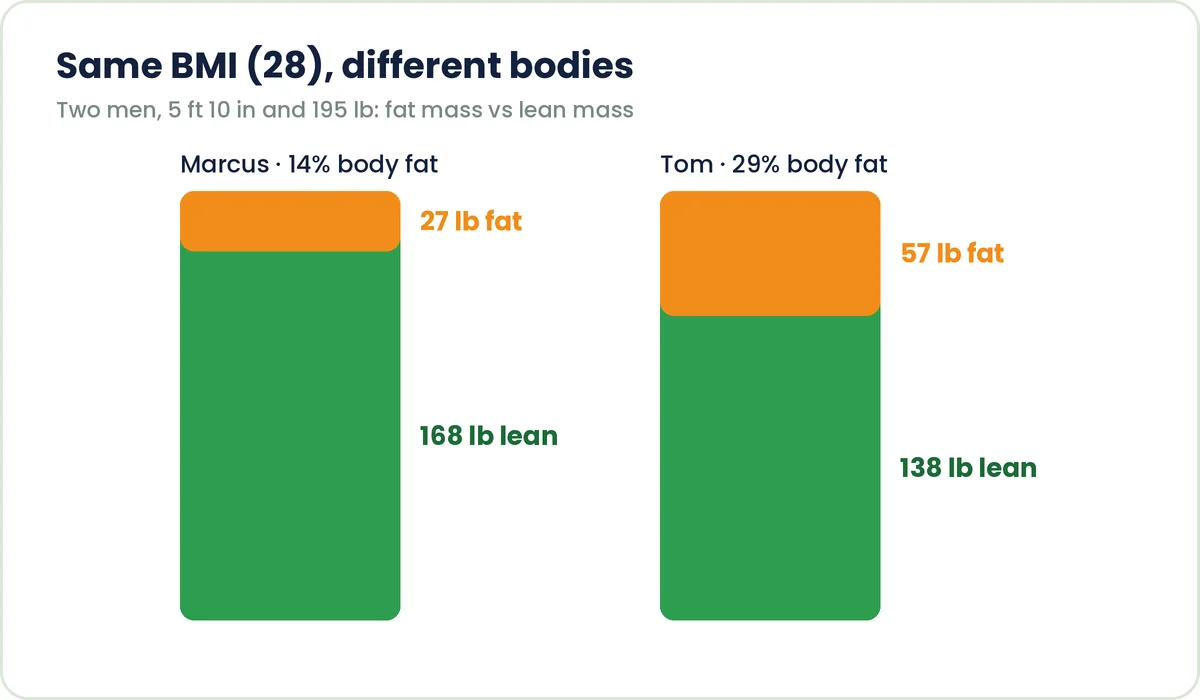
Consider two men who are both 5 ft 10 in and 195 lb. Both have a BMI of 28, "overweight."
- Marcus lifts weights four times a week. His waist is 33 inches and his tape-measure body fat is about 14%. He's lean and muscular.
- Tom doesn't exercise. His waist is 41 inches and his body fat is about 29%. He carries extra fat, much of it around his middle.
BMI treats them as identical. Their waist size and body fat tell completely different stories about their health risk. That's why using more than one measure matters.
Key takeaways
- BMI compares weight to height; it's a fast screening tool but can't tell muscle from fat.
- Body fat percentage shows what your weight is made of and is a better measure of health and fitness.
- Healthy body fat is roughly 14–24% for men and 21–31% for women.
- Keep your waist under half your height; above 40 in (men) or 35 in (women) signals higher risk.
- Track BMI, waist and body fat together for the clearest picture.
Frequently asked questions
Which is more accurate, BMI or body fat percentage?
Body fat percentage is more accurate for judging health and fitness because it separates fat from muscle. BMI is a quicker screening tool that works reasonably well for most non-athletic adults.
What is a healthy body fat percentage?
For most adults, about 14–24% for men and 21–31% for women falls in the fitness to average range. Athletes are often lower: about 6–13% for men and 14–20% for women.
Can you have a normal BMI and high body fat?
Yes. This is sometimes called normal-weight obesity. People with a healthy BMI but high body fat and low muscle can have higher rates of blood pressure, cholesterol and blood sugar problems.
Why is my BMI high if I'm muscular?
BMI only uses height and weight. Muscle is dense and heavy, so muscular people often score as overweight even when their body fat is low.
What BMI corresponds to 25% body fat?
There's no exact conversion, because it depends on age, sex and muscle. For an average man, 25% body fat often lines up with a BMI around 27–29; for an average woman, 32% body fat often lines up with a BMI around 28–30.
How often should I measure body fat?
Every 4–8 weeks is enough. Body fat changes slowly, and measuring too often mostly shows measurement noise.
Sources
- Centers for Disease Control and Prevention. Adult BMI Categories. cdc.gov.
- Romero-Corral A, et al. Normal weight obesity: a risk factor for cardiometabolic dysregulation and cardiovascular mortality. European Heart Journal, 2010.
- American Council on Exercise. Percent Body Fat Norms for Men and Women. acefitness.org.
- Hodgdon JA, Beckett MB. Prediction of percent body fat for US Navy men and women from body circumferences and height. Naval Health Research Center, 1984.
- American Diabetes Association. Standards of Care in Diabetes: Screening for Diabetes in Asian Americans.
- American Medical Association. AMA adopts new policy clarifying role of BMI as a measure in medicine, 2023.
- National Institute for Health and Care Excellence (NICE). Obesity: identification, assessment and management (waist-to-height ratio update), 2022.

We write practical, research-based guides on calories, nutrition and body composition, and build the free calculators on this site. Every article cites its sources and is reviewed for accuracy. Our editorial policy.
This article is for general education and is not medical advice. See our medical disclaimer.
Comments & suggestions