Macros for Weight Loss: How to Calculate and Hit Your Macros
To calculate macros for weight loss, first find your calorie target (maintenance minus about 500 calories). Then set protein at about 0.7–1 g per lb of goal body weight, fat at 20–35% of calories, and fill the remaining calories with carbs. Protein and carbs have 4 calories per gram; fat has 9.
On this page
- What are macros?
- Do macros matter for weight loss, or only calories?
- How to calculate macros for weight loss (5 steps)
- What's the best macro ratio for fat loss?
- High-protein foods to hit your numbers
- Smart carb and fat choices
- How to track your macros
- Sample day: about 2,400 calories, 163 g protein
- How to adjust your macros over time
- Common macro-counting mistakes
- Macros for other goals
- Macros for vegetarians and vegans
- Meal prep makes macros easy
- Macros and intermittent fasting
- Hitting your macros when eating out
- What about alcohol?
- Key takeaways
- Frequently asked questions
Counting calories tells you how much to eat. Counting macros tells you what to eat. If you want to lose fat, keep your muscle and feel full while doing it, getting your macros right is one of the most useful skills you can learn. This guide walks you through the whole process, with a worked example and food lists.
What are macros?
"Macros" is short for macronutrients, the three nutrients that provide calories:
| Macro | Calories per gram | Main job | Common foods |
|---|---|---|---|
| Protein | 4 | Builds and repairs muscle, keeps you full | Chicken, fish, eggs, Greek yogurt, tofu, beans |
| Carbohydrates | 4 | Main fuel for the brain and hard exercise | Rice, oats, potatoes, fruit, bread, pasta |
| Fat | 9 | Hormones, vitamin absorption, cell health | Olive oil, nuts, avocado, cheese, fatty fish |
Alcohol also has calories (7 per gram) but isn't counted as a macronutrient because your body doesn't need it.
Because every gram carries a known number of calories, macros and calories are two views of the same thing. If you eat 150 g protein, 170 g carbs and 55 g fat, that's (150 × 4) + (170 × 4) + (55 × 9) = 1,775 calories.
Do macros matter for weight loss, or only calories?
For the number on the scale, total calories matter most. Controlled feeding studies, including a well-known 2017 metabolic ward study by Kevin Hall at the NIH, found little difference in fat loss between low-carb and low-fat diets when calories and protein were matched.
So why bother with macros? Because they change what you lose and how you feel:
- Protein helps you keep muscle, so more of the weight you lose is fat. It's also the most filling macro.
- Enough carbs fuel your workouts and daily energy.
- Enough fat supports hormones and makes meals satisfying.
Two people can both lose 20 lb. The one with good protein intake and strength training will look leaner and keep a higher metabolism than the one who lost a lot of muscle.
How to calculate macros for weight loss (5 steps)
Step 1: Find your calorie target
Start with your maintenance calories (TDEE) from the TDEE calculator. Subtract about 500 calories to lose roughly 1 lb a week, or 250 for a slower pace. Read our calorie deficit guide if you're not sure which pace fits you.
Example: Mike is 35, 5 ft 11 in, 210 lb, lifts weights three times a week and walks most days, so he's moderately active. His TDEE is about 2,960 calories. His fat-loss target is 2,460 calories.
Step 2: Set protein first
Protein is the most important macro during a diet. A good target is 0.7–1 g per lb of goal body weight (about 1.6–2.2 g per kg). Using goal weight instead of current weight keeps the number realistic for people with a lot of weight to lose.
Mike's goal weight is 185 lb. At 0.9 g per lb, his protein target is about 165 g, which is 660 calories.
Step 3: Set fat
Fat should be 20–35% of calories, the range recommended in the Dietary Guidelines for Americans. Going below about 20% for long periods can affect hormones and make food less satisfying.
Mike picks 28%: 2,460 × 0.28 = 689 calories ÷ 9 = about 77 g of fat.
Step 4: Fill the rest with carbs
Carbs get whatever calories are left. 2,460 − 660 (protein) − 689 (fat) = 1,111 calories ÷ 4 = about 278 g of carbs.
Step 5: Split by meals
Mike eats four times a day, so each meal is roughly 41 g protein, 70 g carbs and 19 g fat. It doesn't need to be exact; hitting your daily totals is what counts.
Shortcut: the macro calculator does all five steps for you, including per-meal splits for 3, 4 or 5 meals.
What's the best macro ratio for fat loss?
There isn't one perfect ratio. The best one is the one you can stick with while getting enough protein. Here are four popular splits and who they suit:
| Split | Protein / Carbs / Fat | Good for |
|---|---|---|
| Balanced | 30 / 40 / 30 | Most people; easiest to follow with everyday foods |
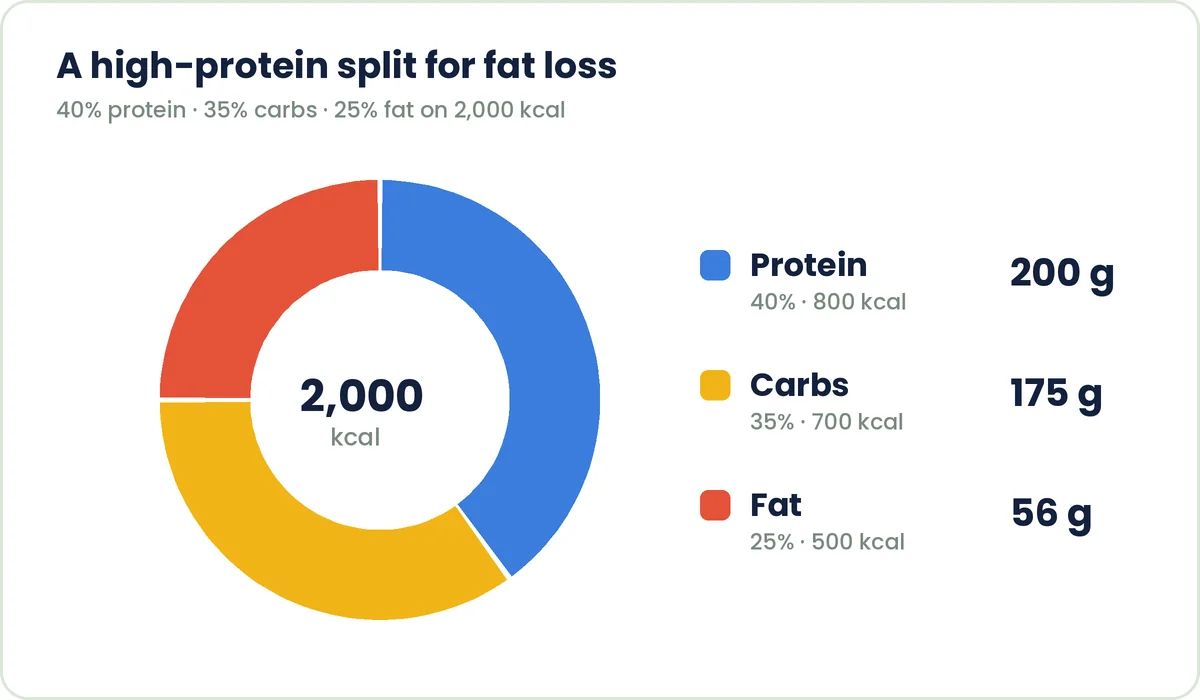
| High protein | 40 / 35 / 25 | Fat loss while lifting; people who get hungry easily |
| Low carb | 35 / 25 / 40 | People who prefer meat, eggs, dairy and vegetables; some people with insulin resistance |
| Keto | 25 / 5 / 70 | People who enjoy very low-carb eating; hard for most to maintain |
If you train hard, run long distances or play sports, you'll usually perform better with more carbs. If you mostly sit at a desk and don't exercise much, a lower-carb split may feel just as good. Try one for three to four weeks, then adjust based on your hunger, energy and progress.
High-protein foods to hit your numbers
Most people struggle with protein more than any other macro. These foods give a lot of protein for their calories:
| Food | Serving | Protein | Calories |
|---|---|---|---|
| Chicken breast, cooked | 4 oz | 35 g | 185 |
| Nonfat Greek yogurt | 1 cup | 23 g | 135 |
| Canned tuna in water | 1 can (5 oz) | 30 g | 130 |
| Egg whites | 1 cup | 26 g | 125 |
| Low-fat cottage cheese | 1 cup | 28 g | 180 |
| Shrimp, cooked | 4 oz | 27 g | 115 |
| 93% lean ground beef, cooked | 4 oz | 28 g | 200 |
| Firm tofu | 6 oz | 17 g | 150 |
| Lentils, cooked | 1 cup | 18 g | 230 |
| Whey protein powder | 1 scoop | 24 g | 120 |
Values are typical and vary by brand. Check labels or the USDA FoodData Central database for exact numbers. For a deeper look, read how much protein you need per day.
Smart carb and fat choices
Carbs that keep you full: potatoes, oats, beans and lentils, berries, apples, whole-grain bread, brown or white rice with plenty of vegetables, and high-fiber wraps. These give energy with more fiber and volume.
Carbs to limit: soda, sweet coffee drinks, candy, pastries and chips. They're easy to overeat and don't keep you full.
Fats worth including: olive oil, avocado, nuts and seeds, salmon and other fatty fish, and eggs. Measure oils and nut butters, since they're calorie-dense.
How to track your macros
- Use an app. Most food-tracking apps show protein, carbs and fat automatically when you log foods.
- Get a kitchen scale. Weighing foods, especially meat, rice, pasta, oils and nut butters, is far more accurate than guessing or using cups.
- Weigh foods raw when you can. Cooked weight changes with water loss, so raw weights are more consistent.
- Plan the day in advance. Log tomorrow's meals the night before, then adjust portions to fit your targets.
- Repeat meals. Having two or three go-to breakfasts and lunches makes tracking fast.
How close is close enough?
You don't need to be perfect. A good target is within about 10 g of protein, 15 g of carbs and 5 g of fat of your goal most days. Your weekly average matters more than any single day.
Sample day: about 2,400 calories, 163 g protein
| Meal | Food | P | C | F |
|---|---|---|---|---|
| Breakfast | Oats (80 g) with 1 scoop whey, 1 banana, 15 g peanut butter | 36 | 88 | 14 |
| Lunch | Burrito bowl: 5 oz chicken, 1.5 cups rice, black beans, salsa, 1/4 avocado | 52 | 97 | 14 |
| Snack | 1 cup Greek yogurt, 1 cup berries, 30 g almonds | 30 | 28 | 18 |
| Dinner | 6 oz salmon, 300 g potatoes, green beans, 1 tsp olive oil | 45 | 65 | 25 |
| Total | 163 | 278 | 71 |
That's about 2,400 calories and within a few grams of Mike's protein and carb targets, with plenty of normal food.
How to adjust your macros over time
- Losing on pace (0.5–1% of body weight per week): change nothing.
- Not losing for 3+ weeks: reduce carbs or fat by about 100–150 calories total. Keep protein the same.
- Losing too fast, feeling weak or training poorly: add 100–200 calories, mostly from carbs.
- Every 10–15 lb lost: recalculate everything, because your TDEE is now lower.
Common macro-counting mistakes
- Setting protein too low. It's the macro that protects your muscle.
- Forgetting cooking oils, sauces and drinks. These can add 300+ hidden calories a day.
- Chasing a "perfect" ratio. Consistency beats precision.
- Cutting fat too low. Stay at or above 20% of calories.
- Never recalculating. Your needs change as your weight changes.
Macros for other goals
The same method works for any goal. Only the calorie target and protein range change:
| Goal | Calories | Protein | Fat | Carbs |
|---|---|---|---|---|
| Lose fat | TDEE − 300 to 500 | 0.7–1 g per lb goal weight | 20–35% | the rest |
| Maintain | TDEE | 0.6–0.8 g per lb | 25–35% | the rest |
| Build muscle | TDEE + 200 to 300 | 0.7–1 g per lb | 20–30% | the rest (higher carbs fuel training) |
| Endurance training | TDEE or higher | 0.55–0.75 g per lb | 20–30% | often 45–65% of calories |
Macros for vegetarians and vegans
Plant-based eaters can hit high protein targets; it just takes a little more planning. Good sources include tofu, tempeh, seitan, edamame, lentils, chickpeas, black beans, Greek yogurt and eggs (for vegetarians), and soy or pea protein powder.
Plant proteins often come with more carbs, so your carb number may end up higher and your fat a bit lower. That's fine. Combining different plant proteins through the day, like beans with rice or hummus with whole-grain pita, gives you a full range of amino acids.
A sample vegan day at about 130 g protein might include: tofu scramble with black beans for breakfast, a lentil and quinoa bowl for lunch, soy yogurt with a scoop of pea protein as a snack, and tempeh stir-fry with edamame and rice for dinner.
Meal prep makes macros easy
Spending 60–90 minutes once or twice a week preparing food removes most of the daily guesswork:
- Cook proteins in bulk: bake 2–3 lb of chicken, brown a pound of lean beef, hard-boil a dozen eggs.
- Cook two carbs: a big pot of rice and a tray of roasted potatoes.
- Roast two trays of vegetables with a measured amount of oil.
- Weigh and portion into containers, and log each container once in your app.
- Keep easy protein snacks on hand: Greek yogurt cups, cottage cheese, jerky, protein bars.
Macros and intermittent fasting
Intermittent fasting, like eating only between noon and 8 p.m., can make a calorie deficit easier for some people because there are fewer eating occasions. It doesn't change the macro math. You still need to hit your calories and protein, which can be harder in a shorter window. If you fast, build each meal around 40–60 g of protein so you still reach your daily total.
Hitting your macros when eating out
Restaurant meals often run 1,000–1,500 calories. You don't have to avoid them:
- Check the menu's nutrition info online. Most US chains publish it.
- Choose a lean protein as the main part of the meal, such as grilled chicken, fish or a burrito bowl with double meat.
- Ask for sauces and dressings on the side.
- Swap fries for a side salad or vegetables.
- Eat a lighter, high-protein breakfast and lunch on days you know you're eating out.
What about alcohol?
Alcohol has 7 calories per gram and doesn't fit neatly into protein, carbs or fat. A standard drink (12 oz beer, 5 oz wine or 1.5 oz spirits) has about 100–150 calories; craft beers and mixed drinks can have 200–400. Most apps log these calories as carbs or fat.
If you drink, the simplest approach is to count the calories and take them from your carb and fat budget for that day while keeping protein the same. Alcohol also tends to lower willpower around food, so plan your meal before you have a drink.
Key takeaways
- Calories decide how much weight you lose; macros decide how much of it is fat and how you feel.
- Set calories first, then protein (0.7–1 g per lb of goal weight), then fat (20–35%), then carbs.
- Protein and carbs = 4 calories per gram; fat = 9.
- Pick a split you enjoy; get close to your numbers most days; adjust every few weeks.
Frequently asked questions
What is the best macro ratio for weight loss?
A high-protein split such as 40% protein, 35% carbs and 25% fat works well for most people losing fat, especially if they lift weights. A balanced 30/40/30 split also works. Total calories and enough protein matter more than the exact ratio.
How do I calculate my macros for weight loss?
Find your maintenance calories, subtract about 500, set protein at 0.7–1 g per pound of goal weight, set fat at 20–35% of calories, and give the remaining calories to carbs. A macro calculator does this automatically.
Is counting macros better than counting calories?
Counting macros includes counting calories, but adds protein, carb and fat targets. It usually leads to better body composition because it makes sure you eat enough protein.
How many grams of protein do I need to lose weight?
Most people losing weight do well with about 0.7–1 g of protein per pound of goal body weight, or 1.6–2.2 g per kilogram.
Can I lose weight eating carbs?
Yes. Weight loss depends on being in a calorie deficit. High-fiber carbs like oats, potatoes, fruit and beans can make a diet easier by keeping you full and fueling exercise.
Do I have to hit my macros exactly every day?
No. Getting within about 10 g of protein, 15 g of carbs and 5 g of fat most days is enough. Your weekly average is what matters.
Sources
- Hall KD, Guo J. Obesity energetics: body weight regulation and the effects of diet composition. Gastroenterology, 2017.
- Helms ER, et al. A systematic review of dietary protein during caloric restriction in resistance trained lean athletes. Int J Sport Nutr Exerc Metab, 2014.
- Morton RW, et al. A systematic review, meta-analysis and meta-regression of the effect of protein supplementation on resistance training-induced gains in muscle mass. Br J Sports Med, 2018.
- US Department of Agriculture and US Department of Health and Human Services. Dietary Guidelines for Americans, 2020–2025.
- USDA FoodData Central. fdc.nal.usda.gov.

We write practical, research-based guides on calories, nutrition and body composition, and build the free calculators on this site. Every article cites its sources and is reviewed for accuracy. Our editorial policy.
This article is for general education and is not medical advice. See our medical disclaimer.
Comments & suggestions