TDEE vs BMR: What's the Difference?
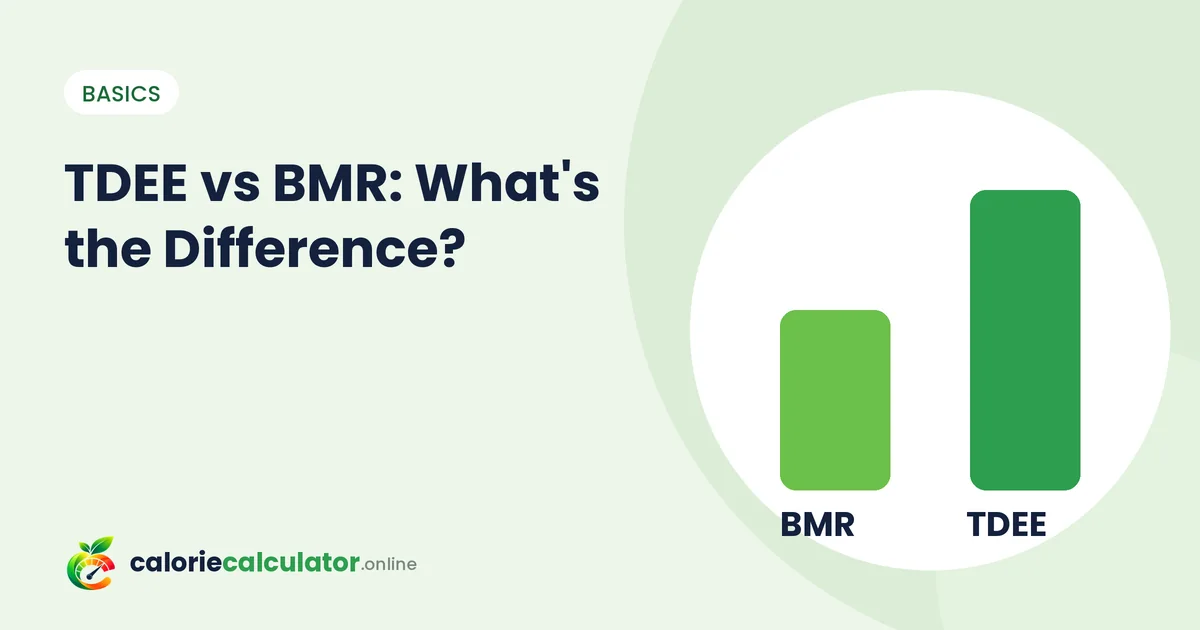
BMR (basal metabolic rate) is the calories your body burns at complete rest. TDEE (total daily energy expenditure) is BMR plus digestion, daily movement and exercise. Base your eating on TDEE, not BMR.
BMR and TDEE are the two numbers behind almost every calorie calculator. BMR is what you burn at rest. TDEE is what you burn in a whole day. Knowing the difference helps you set the right calorie target.
What is BMR?
Basal Metabolic Rate (BMR) is the energy your body uses to stay alive if you stayed in bed all day: breathing, circulating blood, keeping warm and running your brain and organs. For most adults it is 1,200–1,900 kcal a day.
BMR depends mainly on your size, age and sex. Bigger bodies and more muscle burn more. BMR slowly drops with age.
What is TDEE?
Total Daily Energy Expenditure (TDEE) is BMR plus everything else you do:
- Digesting food (about 10% of calories eaten).
- Everyday movement like walking, standing, cooking and fidgeting.
- Exercise.
Calculators estimate TDEE by multiplying BMR by an activity factor, from 1.2 for a desk job with no exercise up to 1.9 for a very physical job plus training.
An example
A 30-year-old man who is 5 ft 9 in and 180 lb has a BMR of about 1,770 kcal. With moderate exercise (factor 1.55), his TDEE is about 2,740 kcal. That TDEE, not the BMR, is his maintenance number.
Which number should you eat?
Base your eating on TDEE. Eat at your TDEE to maintain, below it to lose, above it to gain. Eating only your BMR ignores all your movement and is usually far too low.
Tip: be honest with your activity level. Choosing "Active" when you work a desk job and train 3 times a week is the most common reason calorie targets come out too high.
Try both calculators
Use the BMR calculator to compare three formulas, and the TDEE calculator to see your calories at every activity level.

We write practical, research-based guides on calories, nutrition and body composition, and build the free calculators on this site. Every article cites its sources and is reviewed for accuracy. Our editorial policy.
This article is for general education and is not medical advice. See our medical disclaimer.
Comments & suggestions